

Homemade herbal remedies are my go to for simple cures and simple ailments like a cold, cough or the flu. This immune boosting elderberry cold and flu syrup recipe is naturally high in immune boosting compounds to help beat the cold or flu quickly.
Hence, Elderberries are used to make a variety of remedies, one of my favorites is this immune boosting syrup.
ELDERBERRY- NATURAL REMEDY FOR FLU AND COLDS
Since, my childhood, my grandmother and mother always resorted to homemade remedies for flus, colds and fevers. Only in the worst case scenario we visited a doctor.
As a parent myself, I rely on natural remedies for my child and for all of us in the family for any minor ailments. One of the remedies is by using elderberries.
We are lucky to have elderberries growing in our garden. Elderberries contain natural substances called flavonoids. They seem to help reduce swelling, fight inflammation, and boost the immune system.
Elderberry (Sambucus ), limited studies have found that elderberry eases flu symptoms like fever, headache, sore throat, fatigue, cough, and body aches.

BENEFITS OF ELDERBERRY
Elderberries naturally contain vitamins A, B, and C to stimulate the immune system.
The benefits seem to be greatest if you start taking the syrup within 24 to 48 hours after the symptoms begin. One study found that elderberry could cut the duration of flu symptoms by more than 50%.
A few studies have suggested that elderberry could help with bacterial sinus infections or bronchitis. More research needs to be done on this .
IS IT EASY TO GROW ELDERBERRY BUSH
Elderberry grows almost wild in Europe. I didn’t need to plant one in my garden, because the previous owner planted a variety of native plants and bushes.
If you want to know more about how to grow an elderberry bush, check out this link. How to grow and care for an elderberry bush .
The best time to harvest is between end of August to mid of October.
Our garden has a lot of herbs and plants. As a result of which, I can even make remedies for sick plants.
CAN YOU EAT RAW ELDERBERRIES?
” Although the cooked berries (pulp and skin) of most species of Sambucus are edible, the uncooked berries and other parts of plants from this genus are poisonous. Leaves, twigs, branches, seeds, roots, flowers, and berries of Sambucus plants produce cyanogenic glycosides, which have toxic properties. Ingesting a sufficient quantity of cyanogenic glycosides from berry juice, flower tea, or beverages made from fresh leaves, branches, and fruit has been shown to cause illness, including nausea, vomiting, abdominal cramps, diarrhea, and weakness.”
ELDERBERRY COLD AND FLU SYRUP INGREDIENTS
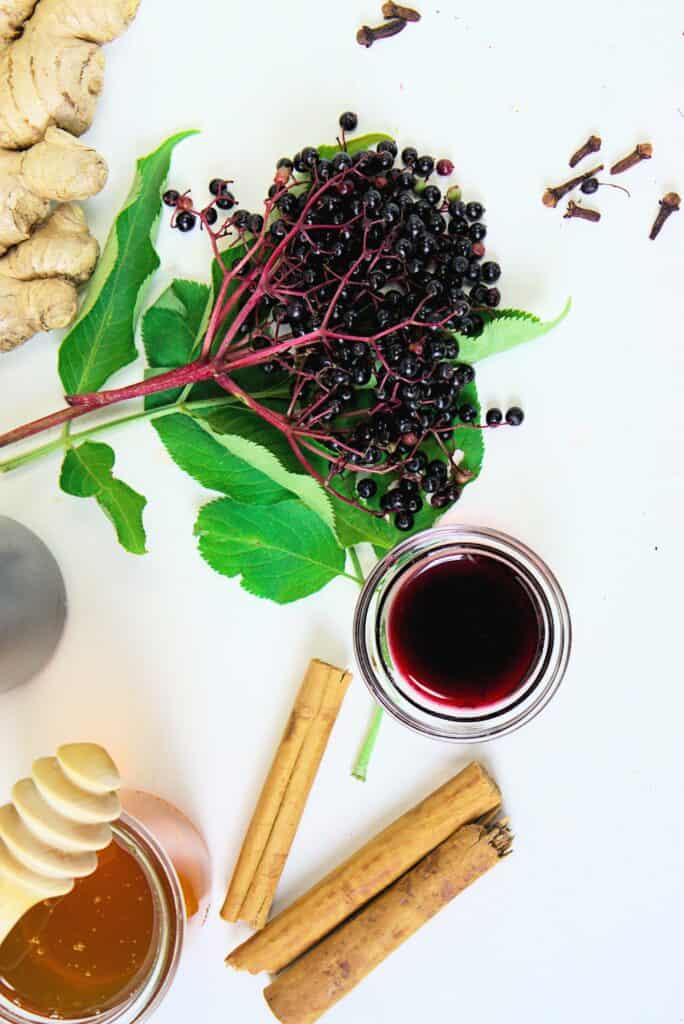
CINNAMON
Cinnamon is a sweet bark and very popular for sweet dishes and is grown Southeast Asia. I am no stranger to this spice, because I use cinnamon in sweets, teas and for regular cooking.
One of the most important active ingredients in cinnamon is cinnamaldehyde. This cinnamaldehyde may be responsible for some of cinnamon’s possible health benefits.
CLOVES
Cloves are another favorite spice of mine. People use the oils, dried flower buds, leaves, and stems to make medicine.
Clove is used directly to the gums for toothache. One of the main ingredients I use in my homemade toothpaste is clove oil.
Clove oil contains a chemical called eugenol which helps to decrease pain and fight infections.

GINGER
Ginger is the spicy and flavorful root of the flowering plant Zingiber officinale. I make teas with ginger, cook with ginger therefore, ginger is a main staple in my kitchen. I use ginger extensively in my cooking. In addition to using ginger as a spice, it is a vital remedy for many ailments according to Ayurveda.
HONEY
Honey is a natural sweetener and studies show that a small amount helps children cough less and sleep better. It has healthy antioxidants, amino acids, and vitamins. The use of honey to treat wounds and burns has been part of traditional medicine for centuries. Honey has natural compounds that fight bacteria, promote healing, prevent infections, and ease swelling. Moreover, honey has an amazing shelf life.
Caution – do not heat honey as the medicinal value is lost. According to Ayurveda, heating honey is poisonous for your body.
WHY I MAKE MY OWN ELDERBERRY COLD AND FLU SYRUP ?
First is of course to save money.
Secondly, I have elderberries growing in my garden and what is better than organically grown and freshly harvested berries. Additionally, all the other ingredients are a staple in my kitchen. So I can make the syrup with minimum effort. Therefore, why bother buying preservative laden cold and cough syrups when the remedy is in my backyard.
Ingredients like ginger, honey and cloves I also anyway what I use to make my Ayurvedic concoctions for similar ailments.
HOW TO MAKE ELDERBERRY COLD AND FLU SYRUP
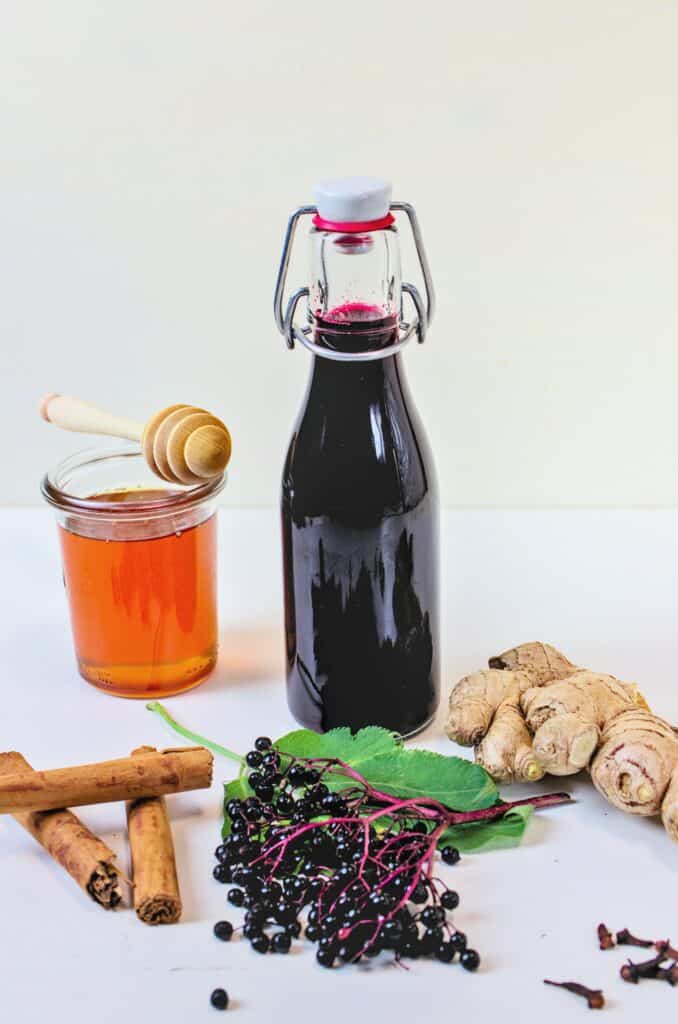
Scroll down for a printable recipe card.
Ingredients
- 1 1/3 cups of fresh elderberries (if you are using dried berries- use 2/3 cups )
- 3 1/2 cups of filtered water
- 1 cup raw honey
- 2- 3 tablespoons of freshly grated ginger
- 1 tsp ground cloves
- 1 tsp cinnamon powder
Instructions
- If you are using fresh berries, remove the berries from the stalks using a fork.
- Wash the berries thoroughly and place the berries into a heavy bottom pot.
- Add water, ginger, cinnamon, and cloves into the berries.
- Bring the mixture to a boil and then cover and reduce to a simmer.
- Cook for about 45 minutes to 1 hour or until the liquid is reduced by almost half.
- Remove from heat and mash the berries carefully using a spoon and strain the liquid.
- When the liquid has cooled to around 38 deg. centigrade add the honey and stir well.
- Store into sterilized glass jar in your fridge.
HOW TO MAKE ELDERBERRY COLD AND FLU SYRUP VIDEO TUTORIAL
HOW LONG CAN YOU STORE THE ELDERBERRY FLU SYRUP?
This depends on you. The syrup should last about 3 months if you store them in sterile conditions. Mine is still good after 2 months.
Alternately, you could freeze small quantities and use as needed.
WHAT IS THE DOSAGE YOU CAN TAKE
According to some herbalists, you can take about a tablespoon once in 3 days to boost your immune system. In case, you are developing flu like symptons, increase the dosage to about 2 teaspoons during the day.
Rule of the thumb I follow, is to take any medicine for 3 days for milder ailments. Because by day 2 you may be feeling well, yet its good to take 1 other day as an extra protection.
CAN I USE ANY OTHER SWEETENERS FOR ELDERBERRY COLD & FLU SYRUP
Vegans do not use honey because of its animal origin. Therefore, you can substitute the syrup with maple syrup or molasses.
Above all, honey is not recommended for babies under 1-2 years old. Some people are also allergic, therefore, you can use alternatives if you are allergic to honey.
Further more, sweeteners help in preserving the syrup. If you choose not to add any consume the syrup quickly.
Another way to consume elderberries is in a tincture form. Since this involves alcohol, only adults can consume it. To make a tincture, mix the concentrated elderberry syrup with equal parts food-grade alcohol like vodka or brandy. Take a few drops as needed.
PIN IT FOR LATER

Ingredients
Instructions

1 comment
[…] I make our harvest last longer by converting them into different recipes like – Elderberry cough syrup, Elderberry compote, Elderberry jam and […]